

Society–Knowledge–Discourse / Parapsychology and Paranormal Phenomena
Since the early 2000s, ghost hunting has become an increasingly popular leisure activity for people who want to come into contact with the “supernatural” through so-called paranormal investigations (PIs) at alleged haunted locations and document paranormal phenomena.
The fascination with the supernatural, often combined with personal experiences in the past or present, is the most frequently cited aspect of the appeal of ghost hunting (GH) and thus probably also the strongest motivation for wanting to join or start a ghost hunting group. A common goal expressed in the GH community is to investigate previously experienced extraordinary events and phenomena more closely and to search for a possible cause. Contact with the supernatural, with ghosts, spirits, or other entities, is primarily established using technical aids. The recordings and measurements are then analyzed, and the results are often made available to the public as research reports on their own websites, on YouTube, and on Facebook.
From a cultural studies perspective, it is particularly interesting to examine the scientific view that ghost hunters adhere to, the roles that mass media and social networks play in the ghost hunting scene, and the potential implications this could have for professional parapsychological counseling, such as that offered by the IGPP.
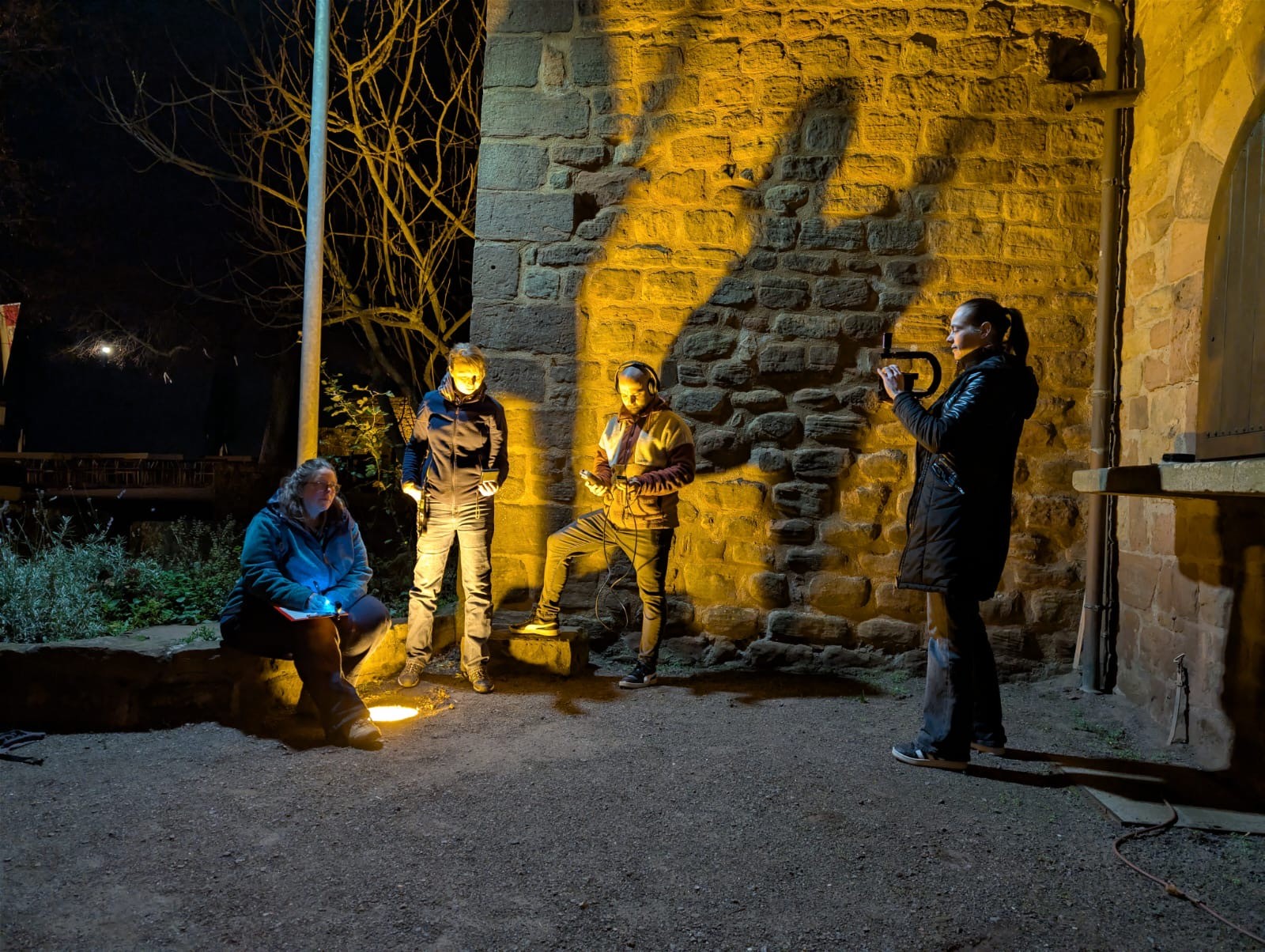
Fig. 1
Ghost hunters in action (copyright: Sonja Nowara)
Selected Projects
Ghost Hunting and Ghost Hunting Groups in Germany
The aim of this research project was to (1) to obtain an overview of the current situation of the ghost hunting scene in Germany, the composition of ghost hunting groups (GHGs), the specific approach to paranormal investigations (PIs), and the extraordinary experiences (ExEs) made in the process, and (2) to better understand the people who pursue this time-consuming and resource-intensive leisure activity. Ghost hunting requires a high level of commitment. We wanted to know what kind of people are drawn to it and what individual motivations the individual ghost hunters have. We also wanted to obtain information about what kind of ExEs prevail and how strong paranormal and supernatural beliefs are among those involved. To this end, we created two questionnaires, the first addressed to entire ghost hunting teams and the second at individuals. In addition to the questionnaire items we created ourselves, the latter also included a questionnaire on extraordinary experiences (Fach, PExE-II) and a questionnaire on paranormal beliefs (Schofield et al., BitSS).
Results Study 1: In many respects, GHGs follow similar models and use techniques and methods familiar from early American and English role models. However, social networks have now largely replaced traditional websites and local television programs as a place to present their own PIs. Differences emerged primarily in the second step, namely data analysis and documentation. In addition, the groups varied greatly in terms of their size and the frequency of PIs per year.
Results of Study 2: As expected, ghost hunters report more ExEs than existing comparison groups and also have more pronounced paranormal beliefs (BitSS), which is understandable given their choice of hobby. Surprisingly, 85% believe in a connection between paranormal phenomena and deceased persons, although 30% describe themselves as atheists or agnostics. This suggests that the belief that the spirits of deceased persons can make themselves known is not necessarily linked to religious belief in a god. Unlike the clientele of the IGPP counseling service, ExEs are generally not disturbing to ghost hunters, but rather arouse curiosity and a desire for further investigation. Almost two-thirds stated that previous ExEs were a significant motivation for taking up ghost hunting.
In addition to the entertainment aspect, the possibility of “real” contact with the paranormal plays an important role for many ghost hunters, something that cannot be found in the media offerings on this topic. Their motivation ranges from scientific interest to the desire to confirm or question their own beliefs.
Project Team
Sonja Nowara
Publications
Mayer, G., & Nowara, S. (2026). Ghost hunting groups and ghost hunters in Germany: Results of two online surveys. Journal of the Society for Psychical Research, (in press).
Nowara, S., & Mayer, G. (2024). Deutsches Ghosthunting—Historischer Überblick und Einblicke einer Insiderin. Journal of Anomalistics / Zeitschrift für Anomalistik, 24(1), 151–188. https://doi.org/10.23793/zfa.2024.151
Mayer, G. (2013). A sample phenomenology of the ghost hunting scene in the USA and in Germany. In O. Jenzen & S. R. Munt (Eds.), The Ashgate research companion to paranormal cultures (pp. 363–376). Ashgate.
Mayer, G. (2010). The ghost hunters are coming: Phenomenology of ghost hunting groups. Journal of Anomalistics, 10(1+2), 17–48.